Vibe Coding: Mastering Prompt Engineering
Master the art of communicating with AIs to create the perfect output.


Happy Tuesday!
Insight Trunk is your lifetime library—a modern replacement for outdated encyclopedias. From Monday to Saturday, we deliver a 10-minute read on a specific subject, with fresh topics each week. Two years later, we revisit each theme with updated insights from our archives—so you’ll never miss a thing. You can unsubscribe anytime using the link at the bottom of this newsletter.
Today, we're diving into the core skill of "vibe coding": mastering prompt engineering. This is the art of talking to AI effectively. We'll learn how to write clear, specific prompts and provide crucial context, transforming your ability to get the precise code you need.
🧑💻 In this week’s edition: Vibe Coding
Monday - Understanding AI Coding Tools
Tuesday - Mastering Prompt Engineering
Wednesday - Building a Basic Frontend App
Thursday - Integrating Backend & APIs
Friday - Debugging and Optimization
Saturday - Advanced Techniques and Scaling
Question of the day
What is the most effective way to provide context to an AI when asking it to generate a new function?
Let’s find out !
Mastering Prompt Engineering
Let’s break it down in today discussion:
Write clear, specific, and concise prompts.
Use context to guide the AI.
Iterate and refine prompts for better results.
Learn to correct and steer the AI.
Read Time : 10 minutes
💻️Write clear, specific, and concise prompts
The efficacy of any AI coding assistant is directly proportional to the quality of the prompts it receives. The initial phase of mastering prompt engineering centers on the fundamental principles of clear, specific, and concise communication. By treating the AI as a highly literal assistant, one can craft prompts that serve as a precise blueprint for the desired code, thereby minimizing ambiguity and the need for subsequent refinement. This foundational skill is critical for achieving optimal results in an AI-assisted workflow.
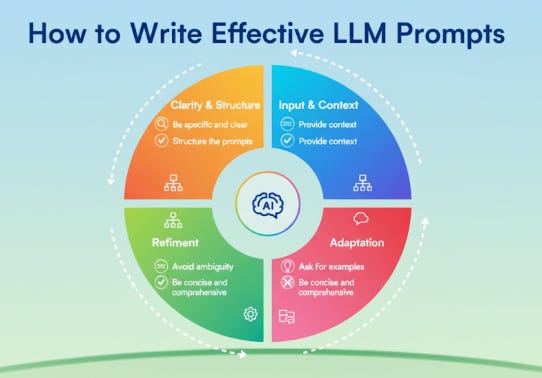
Clarity dictates that the prompt's intent is unmistakable, devoid of vagueness or multiple interpretations. Specificity requires the inclusion of all relevant constraints, such as the intended programming language, the desired function name, specific parameters, and required return types. A command like, "Write a Python function to validate an email address," is good, but a more specific prompt—"Develop a Python function named validate_email that accepts a string parameter and returns a boolean value"—is far more effective. Conciseness ensures the prompt gets straight to the point without unnecessary conversational filler.
By combining these three principles, a developer can consistently guide the AI toward producing highly targeted and usable code. A vague request may yield a generic solution, whereas a meticulously crafted prompt provides the AI with a precise objective, leading to a focused and well-structured response that significantly reduces post-generation editing.
Learn more about what we discussed by watching this video!
⌨️Use context to guide the AI
While clear and specific prompts are the foundation of effective AI interaction, providing relevant context is the critical next step. Contextual information acts as a powerful anchor, enabling the AI to generate code that is not only functional but also perfectly aligned with your project's unique conventions, naming schema, and established architectural patterns. This approach transcends simple instructions and allows for a more sophisticated, tailored output.

A key technique for providing this guidance is few-shot prompting, where you include one or more examples of the desired code pattern or style directly in your prompt. For instance, if your project exclusively uses async/await syntax for asynchronous operations, you can provide an example of an existing async function. By doing so, your subsequent requests for new asynchronous functions will be met with code that mirrors that specific syntax, eliminating the need for manual refactoring.
This method extends to more granular tasks, such as creating new methods within an existing class. By including the full class definition in your prompt, you provide the AI with a complete context of available properties and methods. This ensures the newly generated method correctly accesses and utilizes the class's internal state, leading to a seamless and functional addition to your codebase. This powerful technique significantly reduces the need for post-generation edits.
🖥️Iterate and refine prompts for better results
The misconception that an AI assistant will produce a perfect solution from a single prompt is a significant barrier to effective utilization. In reality, prompt engineering is an iterative and collaborative process. The initial output should be viewed as a starting point, a draft that serves as the foundation for subsequent refinement. This disciplined approach acknowledges that the developer's ongoing feedback is essential for unlocking the AI's full problem-solving potential.
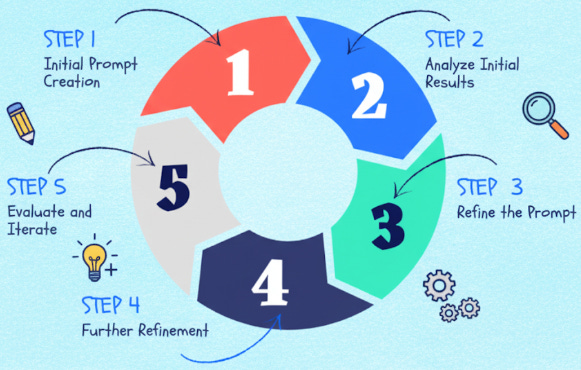
This iterative process is best conceptualized as a continuous feedback loop. Upon receiving an initial output, a developer must meticulously analyze its quality, efficiency, and adherence to project requirements. For instance, an AI might correctly generate a function but implement a sub-optimal algorithm or fail to handle specific edge cases. The developer's task is to identify these specific shortcomings and use them to construct a more precise and constrained follow-up prompt.
Consider a scenario where the initial prompt is, "Write a Python function to sort a list of numbers." The AI might provide a solution using a standard sort algorithm. A refined prompt, however, could be, "Refine the previous function to sort the list in descending order without using the built-in sort() method." This demonstrates how a developer actively guides the AI toward a more specific or challenging solution, effectively elevating the quality of the final code.
This video will give you further insights into the topic.
🖱️Learn to correct and steer the AI
Moving beyond simple iteration, a developer must learn to actively "steer" the AI to align its output with highly specific requirements and professional standards. This level of control is achieved by providing explicit instructions that either guide the AI toward a preferred solution or constrain it from using undesirable patterns. This proactive approach ensures the final code is not only functionally correct but also consistent with a project's style guide and best practices.

A powerful method for steering is the use of negative constraints. This involves explicitly telling the AI what to avoid. For example, a prompt could be, "Implement this data validation function without using an external library," or "Refactor this code, but do not use a recursive approach." By setting these explicit boundaries, you compel the AI to explore alternative algorithms and design patterns, which can lead to more efficient, maintainable, or secure solutions that you might not have considered.
Furthermore, developers can enforce specific coding standards and stylistic conventions. This might include instructing the AI to "use f-strings for all string formatting in Python" or to "implement error handling using a consistent try/catch block." By providing these detailed rules, you effectively train the AI to adhere to your personal or team's style guide, ensuring the codebase remains clean and uniform regardless of which team member—or AI—generates the code.
Summary
The Foundation of Good Prompts
To get the best results from an AI assistant, prompts must be clear, specific, and concise.
A vague request will lead to a generic and unhelpful response from the AI.
A well-defined prompt provides the AI with a precise objective, which yields a targeted and useful solution.
Mastering this fundamental skill is crucial for all future interactions with the AI assistant.
The Power of Context
Providing relevant context is essential for guiding the AI's output beyond simple functionality.
Techniques like "few-shot prompting" involve including existing code or examples in your request.
This method allows the AI to learn your desired style, syntax, and architectural patterns.
Using context ensures the generated code seamlessly integrates with your project's conventions, saving significant time on manual alignment.
Iteration and Refinement
Do not expect a perfect result from your first prompt; prompt engineering is an iterative process.
View the initial AI output as a starting point that requires your continuous feedback.
Analyze the shortcomings of the first response and use that insight to refine your next prompt with more specific constraints.
This disciplined cycle of refining your requests is what truly unlocks the AI's problem-solving potential.
Correcting and Steering the AI
Active prompt engineering involves a direct, corrective dialogue with the AI to enforce specific rules and styles.
You can use negative constraints, such as telling the AI what to avoid, to force it toward alternative solutions.
It's also possible to explicitly instruct the AI on best practices and preferred syntax to maintain code consistency.
This level of control ensures the final code adheres to your project's standards, regardless of who—or what—generated it.
Hacks for mastering prompt engineering.
The "Role-Playing" Prompt - Begin your prompt by assigning the AI a specific role, such as "You are a senior JavaScript developer specializing in React," to get more relevant code.
The "ELI5" Technique - When you get stuck, use the "Explain it like I'm 5" method to have the AI simplify complex code into understandable concepts.
The "Context Block" - Paste a block of your existing code at the beginning of your prompt, so the AI has all the necessary context to generate a coherent response.
The "Negative Constraint" - Tell the AI what you don't want, such as "Do not use a
forloop," to force it to find a different solution.The "Chain of Thought" - Instruct the AI to "think step by step" before providing the final code, which often leads to a more logical and robust solution.
The "Foreign Language" Test - Translate a prompt into a different language and then back into English to see if the AI can provide a different, sometimes better, solution.
Answer of the day
What is the most effective way to provide context to an AI when asking it to generate a new function?
Provide existing code examples.
Providing a few lines of existing, relevant code within your prompt is highly effective. This technique, known as "few-shot prompting," gives the AI a clear pattern to follow, showing it the desired style, syntax, and logic. This eliminates ambiguity and enables the AI to generate a solution that integrates seamlessly with your codebase.
That’s A Wrap!
Want to take a break? You can unsubscribe anytime by click this link at the bottom of your email.