

Nutrition: Macronutrients
Carbs, Protein, and Fats: The Big Three that Provide Energy and Structure.


Happy Monday!
Insight Trunk is a free lifetime library—a modern replacement for outdated encyclopedias. From Monday to Saturday, we deliver a 10-minute read on a specific subject, with fresh topics each week. Two years later, we revisit each theme with updated insights from our archives—so you’ll never miss a thing. You can unsubscribe anytime using the link at the bottom of this newsletter.
Today, we dive into the macronutrients: the core components of every meal. We’ll explore how carbohydrates fuel your body, how proteins build and repair tissue, and the essential role fats (lipids) play in energy and cell health. Understanding these three is key to nutrition.
🧑💻 In this week’s edition: Nutrition
Monday - Macronutrients
Tuesday - Micronutrients
Wednesday - Digestion, Absorption, and Metabolism
Thursday - Energy Balance and Weight Management
Friday - Diet Planning and Food Guidelines
Saturday - Contemporary and Applied Nutrition
Question of the day
What is the primary macronutrient used by the body for immediate, quick energy?
Let’s find out !
Macronutrients
Let’s break it down in today discussion:
Carbohydrates: The Essential Primary Fuel Source
Proteins: The Structural and Functional Powerhouses
Fats (Lipids): Essential Energy and Structural Components
Calculating Energy: Calories and Balance
Read Time : 10 minutes
⛽ Carbohydrates: The Essential Primary Fuel Source
Carbohydrates represent the foundational macronutrient for energy provision in the human body. Biochemically, they are organic compounds composed of carbon, hydrogen, and oxygen, primarily categorized as sugars, starches, and fiber. The ultimate function of digestible carbohydrates is to be broken down into glucose, the most readily utilized form of energy for all tissues, particularly the brain and central nervous system.

Dietary carbohydrates are broadly classified as simple (e.g., fructose in fruit, sucrose in table sugar) and complex (e.g., starches found in whole grains, legumes, and potatoes). Simple carbohydrates offer quick bursts of energy, whereas complex carbohydrates require more time to digest, providing a sustained and consistent energy release. Selecting nutrient-dense, whole-food sources, such as oats, brown rice, and berries, optimizes overall nutrient intake.
A consistent supply of glucose is critical for maintaining cognitive function and supporting physical activity. When intake is insufficient, the body must resort to less efficient processes, such as breaking down fats or proteins for fuel. Therefore, incorporating appropriate carbohydrate sources is essential for proper physiological function and energy maintenance.
Watch this video to explore how carbohydrates impact your health.
🏗️ Proteins: The Structural and Functional Powerhouses
Proteins are indispensable macronutrients critical for the structural integrity and regulation of the body. These complex molecules are polymers constructed from chains of amino acids, often referred to as the “building blocks” of life. There are twenty distinct amino acids, nine of which are considered essential, meaning they must be obtained through the diet.

The primary role of protein extends far beyond muscle tissue repair; it is central to the synthesis of enzymes, which catalyze virtually all biochemical reactions, and hormones, which act as chemical messengers. Moreover, proteins are vital components of the immune system, forming antibodies that defend against pathogens, and they are essential for the maintenance of fluid and pH balance.
Dietary sources of protein are diverse and include both animal products (e.g., meat, dairy, eggs) and plant-based options (e.g., legumes, nuts, seeds). A complete protein source is one that provides all nine essential amino acids. Ensuring a consistent, quality protein intake is fundamental for cellular regeneration, growth, and overall metabolic health.
Let’s explore Highest Protein Foods In The World with this video.
💧 Fats (Lipids): Essential Energy and Structural Components
Fats, or lipids, are a crucial class of macronutrients characterized by their insolubility in water. They serve multiple vital roles, primarily acting as the most concentrated source of energy, yielding nine calories per gram, which is significantly more than carbohydrates or proteins. This density makes them essential for long-term energy storage and insulation, helping to maintain body temperature.

Beyond energy, lipids are integral to cellular architecture. They form the phospholipid bilayer of all cell membranes, regulating what enters and exits the cell. Furthermore, dietary fats are indispensable for the absorption and transportation of the fat-soluble vitamins—Vitamins A, D, E, and K—without which these micronutrients cannot be utilized by the body.
Fats are categorized as saturated, monounsaturated, or polyunsaturated, with the latter two, found in sources like avocados, nuts, and olive oil, being particularly beneficial for cardiovascular health. These healthy fats provide essential omega-3 and omega-6 fatty acids, which play critical roles in brain function, inflammation control, and blood clotting.
Watch this video to learn the Difference Between Saturated And Unsaturated Fat.
⚖️ Calculating Energy: Calories and Balance
The energy provided by macronutrients is quantified using the unit kilocalorie (kcal), commonly referred to as the calorie. Understanding the caloric content of each macronutrient is foundational to calculating dietary energy intake. Specifically, both carbohydrates and protein yield approximately four kcal per gram, whereas fat provides a much higher density of nine kcal per gram. This differential caloric value underscores the importance of balanced portion control.
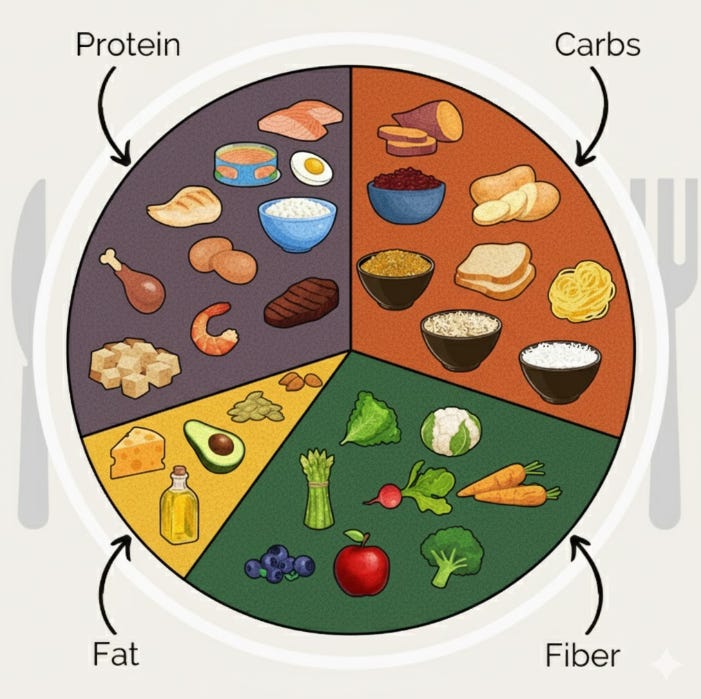
The concept of energy balance is central to weight management and overall health. It describes the relationship between Energy In (the calories consumed from food and drink) and Energy Out (the calories expended through basal metabolic rate, physical activity, and thermogenesis). A state of equilibrium, where intake equals expenditure, maintains current body weight.
To illustrate, consuming a consistent energy surplus (intake exceeds expenditure) results in weight gain, as the excess energy is stored, primarily as body fat. Conversely, a caloric deficit (expenditure exceeds intake) is necessary for weight loss. Therefore, precise calculation and monitoring of macronutrient consumption and expenditure are critical for achieving specific body composition goals.
Summary
Carbohydrates – Essential Energy
Carbohydrates are the primary fuel source for the entire body.
They are broken down into glucose, which is vital for brain and nervous system function.
Simple carbs offer quick energy; complex carbs provide a slower, sustained release.
Prioritizing nutrient-dense sources like whole grains ensures stable energy supply.
Proteins – Structure and Regulation
Proteins are composed of amino acids and are the structural components of all tissues.
Their main function is to build, repair, and maintain muscles, skin, and organs.
Proteins are essential for creating regulatory molecules like enzymes and hormones.
Inadequate protein affects immune defense and the body’s growth processes.
Fats (Lipids) – Dense Energy and Absorption
Fats are the most energy-dense macronutrient, used for long-term energy storage and insulation.
They are critical for forming healthy cell membranes throughout the body.
Fats are necessary for the absorption of the fat-soluble vitamins (A, D, E, K).
Healthy fats (monounsaturated/polyunsaturated) support brain and cardiovascular health.
Calculating Energy – Calories and Balance
The energy provided by food is measured in calories (kcal), with fats having the highest value per gram.
Carbohydrates and protein yield 4 kcal/g; fat yields 9 kcal/g.
Energy balance is the key relationship between calories consumed and calories expended.
A surplus leads to weight gain, while a deficit is necessary for weight loss.
Five sneaky ways to boost your protein
The Protein Coffee: Add a scoop of protein powder to your morning coffee or smoothie for a quick and creamy energy boost.
The Crunchy Snack Swap: Replace chips with roasted chickpeas or edamame for a high-protein, guilt-free bite.
The Greek Upgrade: Choose Greek yogurt over regular yogurt to double your protein intake without changing your routine.
The Seed Sprinkle: Top your salad or oatmeal with hemp or chia seeds for a simple protein and fiber boost.
The Quinoa Switch: Swap rice for quinoa to add a complete plant-based protein to your meals.
Answer of the day
What is the primary macronutrient used by the body for immediate, quick energy?
Carbohydrates (specifically glucose).
Carbohydrates are broken down into glucose, which is the body’s preferred and most readily available source of energy. This fuel is crucial for brain function and high-intensity activities. Protein and fats serve primarily as structural components and long-term energy stores, making carbs the quick-access power source.
That’s A Wrap!
Want to take a break? You can unsubscribe anytime by clicking “unsubscribe” at the bottom of your email.