

Electrical Engineering: Signal Processing and Communications
Analyzing Information Signals in Time and Frequency Domains for Communication Systems.

Happy Saturday!
Insight Trunk is a free lifetime library—a modern replacement for outdated encyclopedias. From Monday to Saturday, we deliver a 10-minute read on a specific subject, with fresh topics each week. Two years later, we revisit each theme with updated insights from our archives—so you’ll never miss a thing. You can unsubscribe anytime using the link at the bottom of this newsletter.
We conclude our overview by analyzing how information travels. You’ll learn to differentiate analog and digital signals, explore the frequency domain using Fourier, understand signal transmission via modulation (AM/FM), and identify the basic components of wireless systems.
🧑💻 In this week’s edition: Electrical Engineering
Monday - Fundamentals of Electricity
Tuesday - DC and AC Circuit Analysis
Wednesday - Electronics and Semiconductors
Thursday - Digital Systems and Microcontrollers
Friday - Electromagnetics and Machines
Saturday - Signal Processing and Communications
Question of the day
What is the term for shifting an information signal’s frequency to higher ranges?
Let’s find out !
Signal Processing and Communications
Let’s break it down in today discussion:
The Nature of Electrical Signals
Frequency Domain Analysis via Fourier
Efficient Signal Transmission via Modulation
Architecture of a Wireless Communication System
Read Time : 10 minutes
📊 The Nature of Electrical Signals
The initial step in signal processing necessitates a clear distinction between the two primary classes of electrical signals used to convey information: analog and digital. These represent fundamentally different approaches to data representation and handling.
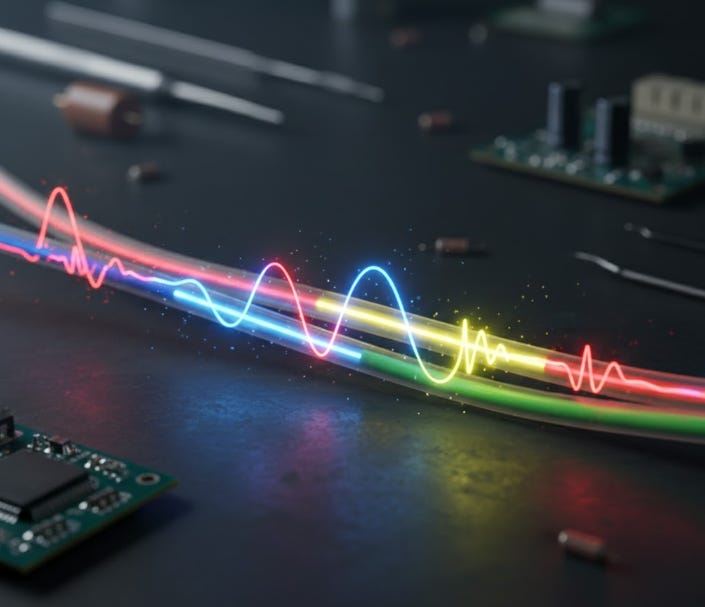
Analog Signals are characterized by being continuous in both time and amplitude. They can assume any value within a given range at any instant. Examples include natural phenomena such as sound waves, light intensity, and voltage from traditional sensors like thermocouples. While analog signals capture continuous variation accurately, they are inherently vulnerable to noise and attenuation, meaning the original information can be easily degraded during transmission or storage.
In contrast, Digital Signals are discrete in both time and amplitude. They exist only at specific time intervals and are constrained to a finite, usually small, set of values, typically represented by two binary states: High (1) and Low (0). This discrete representation makes them significantly more robust against noise, as minor fluctuations do not alter the intended binary state. Modern systems rely on Analog-to-Digital Converters (ADCs) to sample and quantize analog data into the digital format necessary for microprocessors and high-fidelity communication.
Learn more about what we discussed by watching this video!
〰️ Frequency Domain Analysis via Fourier
While electrical signals are naturally observed and recorded in the time domain (amplitude as a function of time), analyzing signals in the frequency domain (amplitude as a function of frequency) offers unparalleled insight into their underlying structure, noise content, and required bandwidth.
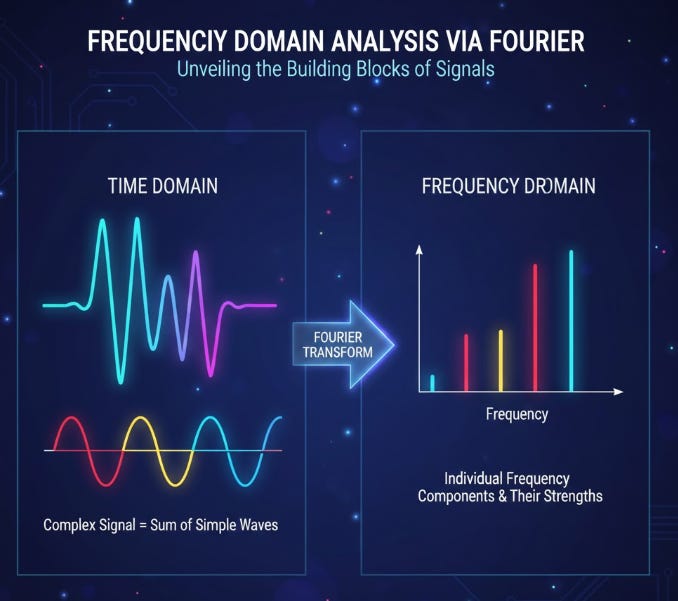
The transition from the time domain to the frequency domain is achieved using the Fourier Series (for periodic signals) and the Fourier Transform (for non-periodic signals). The core mathematical premise, developed by Joseph Fourier, is that any complex waveform can be precisely decomposed into a unique sum of simple sinusoidal components (sine and cosine waves). Each sinusoid has a specific amplitude, frequency, and phase.
Plotting the amplitude of these constituent sine waves against their respective frequencies yields the signal’s frequency spectrum. This analysis is crucial for engineers designing filters and communication systems. For example, identifying the specific frequencies where noise is concentrated allows for the precise design of a filter to remove it without affecting the desired signal frequencies. Furthermore, the spectrum reveals the bandwidth required to transmit the signal accurately, which is the range of frequencies necessary to represent the information.
Broaden your understanding by watching this video.
📻 Efficient Signal Transmission via Modulation
Modulation is a critical process in communication engineering where the properties of a high-frequency signal, termed the carrier wave, are systematically altered according to the characteristics of the low-frequency information signal, known as the baseband signal (e.g., voice or music). This frequency translation is essential because baseband signals cannot be transmitted efficiently via antennas or multiplexed with other signals.
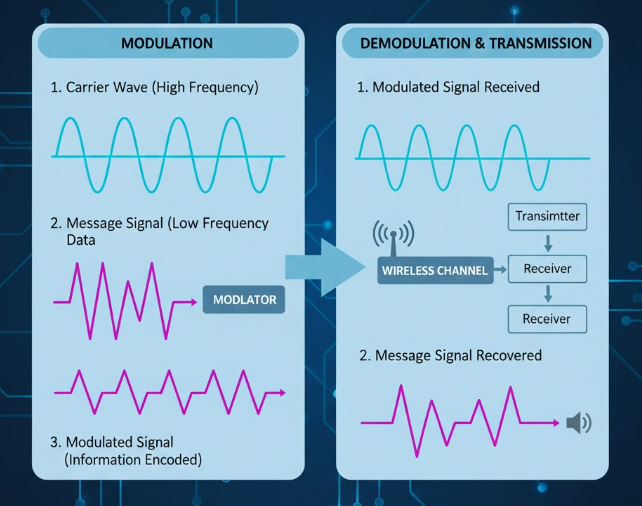
Two principal analog modulation techniques are widely employed. In Amplitude Modulation (AM), the instantaneous amplitude (voltage magnitude) of the carrier wave is varied in direct proportion to the amplitude of the baseband signal. AM systems are relatively simple to implement but suffer from a significant drawback: they are highly susceptible to noise, as most common sources of interference and static primarily affect the signal’s amplitude.
In contrast, Frequency Modulation (FM) varies the instantaneous frequency of the carrier wave in proportion to the amplitude of the baseband signal, while the carrier’s amplitude remains constant. This is a crucial advantage because external noise sources predominantly impact the amplitude, meaning FM receivers can largely ignore noise-induced amplitude variations. Consequently, FM offers superior fidelity and noise immunity, though it requires a larger bandwidth for transmission compared to AM.
This video offers comprehensive details on the subject.
📶 Architecture of a Wireless Communication System
A functional wireless communication system is structured around several interconnected stages designed for efficient signal transmission and reception through the atmosphere (the channel). These stages ensure that information is successfully transmitted, propagated, and recovered.
The process begins at the Transmitter, which has the responsibility of conditioning the baseband signal. This includes noise reduction, coding (to add redundancy for error correction), and crucially, modulation (shifting the signal to a high-frequency carrier wave). The modulated signal is then amplified to sufficient power levels and fed into the Antenna, which acts as the transducer, converting the electrical signal into propagating electromagnetic waves for transmission into free space.

The Channel represents the transmission medium, which introduces inherent impairments such as attenuation (signal weakening over distance), noise (random interference), and multipath fading (signal reflections causing interference). At the receiving end, the Receiver Antenna intercepts the extremely weak electromagnetic waves and converts them back into an electrical signal. This signal is then significantly amplified and subjected to demodulation, the inverse process of modulation, to strip away the carrier and recover the original baseband information signal.
The ability to accurately and robustly recover the signal in the presence of channel impairments defines the performance and reliability of the entire wireless link, from satellite communications to cellular networks.
For a complete overview, watch this video.
Summary
Defining Signal Types
Analog signals are continuous, meaning they can assume any value at any time, such as a microphone voltage.
Analog signals are prone to degradation from noise and signal loss during transmission.
Digital signals are discrete, using only specific values (like $0$ and $1$) at specific time intervals.
Digital signals are significantly more robust and resistant to noise interference.
ADCs and DACs are the devices used to translate information between the analog and digital formats.
Analyzing Signals in Frequency
Signals are commonly viewed in the time domain (amplitude vs. time), but the frequency domain (amplitude vs. frequency) offers richer analysis.
The Fourier Series/Transform is the mathematical tool used to decompose complex signals into simpler sine wave components.
The frequency domain plot, or spectrum, identifies all the unique frequencies contained within the signal.
Analyzing the spectrum helps engineers determine the required bandwidth and design filters to isolate desired signal components or remove noise.
The Need for Modulation
Modulation is the technique that shifts the low-frequency information signal (baseband) to a high-frequency carrier wave.
This frequency shift is necessary to enable efficient signal radiation via antennas for wireless transmission.
In Amplitude Modulation (AM), the amplitude of the carrier is varied by the information signal, making it vulnerable to noise.
In Frequency Modulation (FM), the frequency of the carrier is varied, offering superior noise immunity because noise primarily affects amplitude.
Key Elements of Wireless Systems
The Transmitter processes the information (modulation, amplification) and feeds the high-frequency signal to the antenna.
The Antenna converts the electrical signal into electromagnetic waves and vice versa, acting as the interface to the channel.
The Channel (free space or medium) inevitably introduces signal impairments such as noise and attenuation.
The Receiver captures the weak signal, amplifies it, and performs demodulation to successfully extract the original baseband information.
Book List for Advanced Communication System Study.
“Communication Systems” by Simon Haykin: This is a classic textbook providing a thorough and rigorous treatment of both analog and digital communication theory and noise analysis.
“Digital Communications” by John G. Proakis: Considered the definitive reference for digital communications, covering key topics like coding, synchronization, and advanced modulation techniques.
“Principles of Communication Systems” by Herbert Taub and Donald Schilling: An excellent, highly-rated resource that offers a clear and in-depth explanation of basic and advanced modulation theories.
“Antenna Theory: Analysis and Design” by Constantine A. Balanis: This book is essential if you want to understand the physical interface between the electrical circuit and the radio channel.
“Signals and Systems” by Alan V. Oppenheim and Alan S. Willsky: A foundational text for understanding the mathematical tools, like the Fourier Transform, used to analyze signals in the time and frequency domains.
Answer of the day
What is the term for shifting an information signal’s frequency to higher ranges?
Modulation.
Modulation is the process of embedding information onto a high-frequency carrier wave. This frequency shift is necessary because low-frequency information signals (like voice) cannot efficiently travel long distances through the air; the carrier makes wireless transmission possible.
That’s A Wrap!
Want to take a break? You can unsubscribe anytime by clicking “unsubscribe” at the bottom of your email.