

Earth Systems: Physical Earth Systems
Exploring the inner structure, dynamic crust, and essential water systems of the Earth.

Happy Monday!
Insight Trunk is a free lifetime library—a modern replacement for outdated encyclopedias. From Monday to Saturday, we deliver a 10-minute read on a specific subject, with fresh topics each week. Two years later, we revisit each theme with updated insights from our archives—so you’ll never miss a thing. You can unsubscribe anytime using the link at the bottom of this newsletter.
Today, we dive into the Geosphere and Hydrosphere. We’ll explore Earth’s dynamic plate tectonics and how they shape our continents and mountains. We’ll also examine the water cycle, focusing on oceans, ice (cryosphere), and vital groundwater systems that sustain life.
🧑💻 In this week’s edition: Earth Systems
Monday - Physical Earth Systems
Tuesday - Climate, Atmosphere, and Biosphere
Wednesday - Human Impact and Environmental Issues
Thursday - Geography and Spatial Analysis
Friday - Sustainable Development Principles
Saturday - Solutions and Future Pathways
Question of the day
What geological process drives the movement of continents and forms major landforms like the Himalayas?
Let’s find out !
Physical Earth Systems
Let’s break it down in today discussion:
Geosphere Dynamics: Structure and Plate Tectonics
Material Cycling: Rock, Soil, and Weathering
Global Water Dynamics: Hydrosphere and Circulation
Freshwater Resources and Management Imperatives
Read Time : 10 minutes
🧱 Geosphere Dynamics: Structure and Plate Tectonics
The Earth’s architecture is fundamentally layered. The outermost solid shell, the lithosphere (comprising the crust and the rigid uppermost mantle), floats atop the semi-molten asthenosphere. This structural composition dictates the planet’s dynamic geological activity.
This lithospheric layer is segmented into vast, irregularly shaped tectonic plates. The movement of these plates, known as plate tectonics, is driven by internal thermal energy manifesting as mantle convection currents. The consequential interactions at plate boundaries define Earth’s surface features.
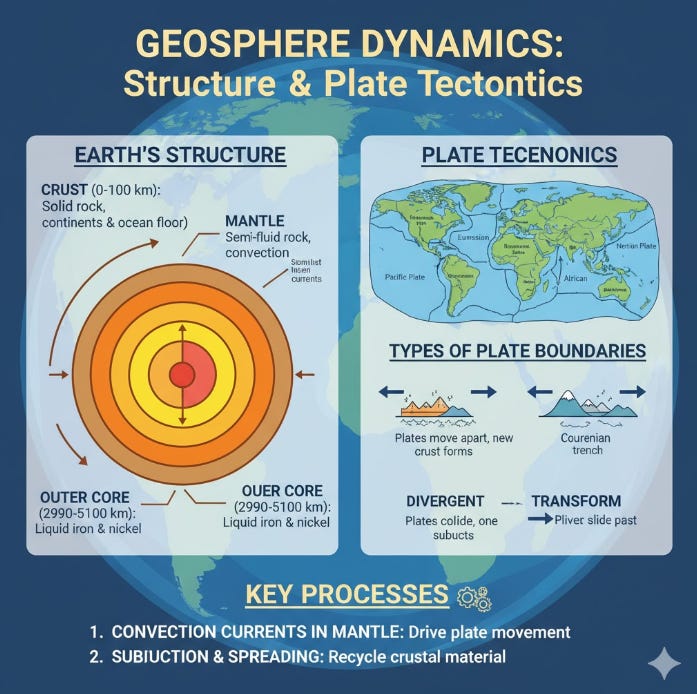
Three principal boundary types exist: convergent boundaries, where plates collide (e.g., forming the Himalayas); divergent boundaries, where new crust is created as plates pull apart (e.g., the Mid-Atlantic Ridge); and transform boundaries, where plates slide past each other (e.g., the San Andreas Fault). These processes are the primary cause of seismicity and volcanism, systematically shaping major landforms and continents over geological time scales.
Watch this video to explore the topic in more detail.
⛏️ Material Cycling: Rock, Soil, and Weathering
The rock cycle represents the Earth’s continuous mechanism for recycling lithospheric material, ensuring the planet’s surface is perpetually renewed. This cycle interconnects the three primary rock classifications. Igneous rocks form from the solidification of molten magma or lava (e.g., granite and basalt). These rocks are subsequently broken down and redeposited to form sedimentary rocks through processes like compaction and cementation (e.g., sandstone and limestone). Finally, intense heat and pressure can transform either of the preceding types into metamorphic rocks (e.g., marble and slate).
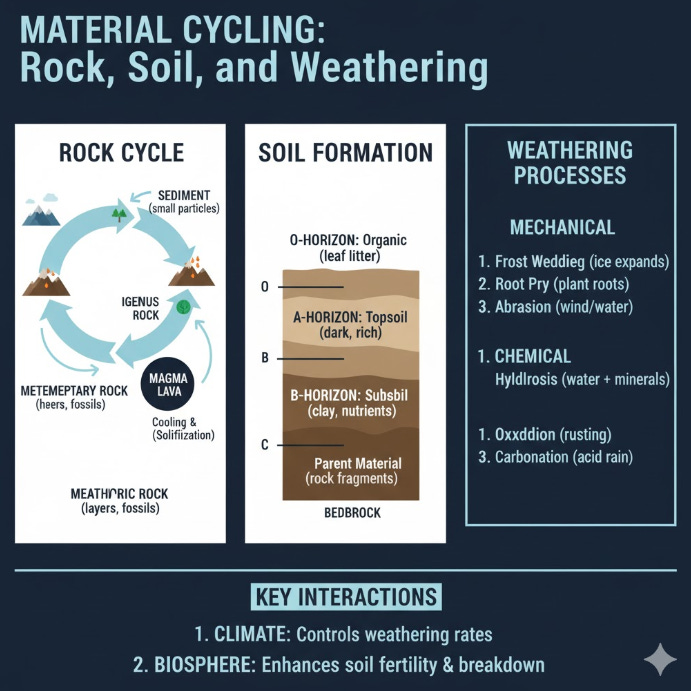
A crucial initial step in this cycle is weathering, the mechanical or chemical disintegration of rocks exposed at the surface. Physical weathering, such as freeze-thaw cycles, breaks rock into smaller fragments. Chemical weathering, such as dissolution or oxidation, alters the rock’s mineral composition.
These weathered fragments, when mixed with decomposed organic matter, water, and air, undergo pedogenesis (soil formation). Soil is a vital, dynamic interface that supports terrestrial ecosystems and agriculture. Its composition and depth are direct results of the parent rock material, climate, topography, and the actions of living organisms over extended periods.
Get a deeper understanding about the rock cycle with this video.
💧 Global Water Dynamics: Hydrosphere and Circulation
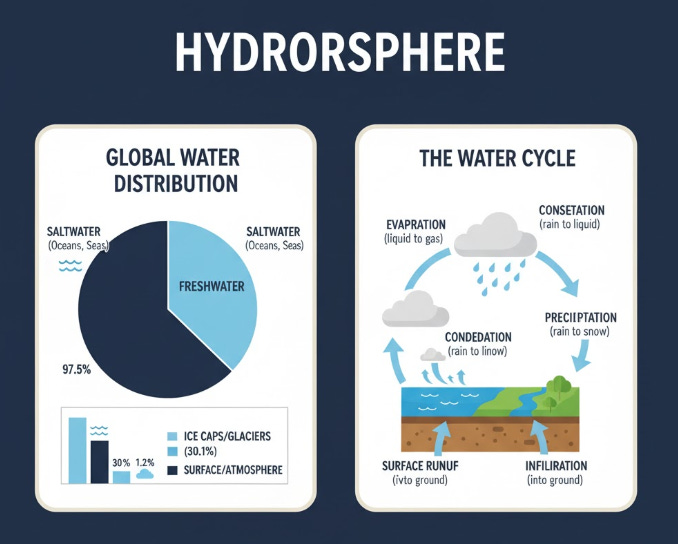
The Hydrosphere, which encompasses all water in its solid, liquid, or gaseous state, is crucial for Earth’s energy and climatic systems. The continuous circulation of water is governed by the hydrologic cycle. This process involves evaporation from surfaces, transpiration from plants, subsequent condensation forming clouds, and eventual return to the surface as precipitation. The oceans are the largest reservoir, driving much of this global circulation.
Oceanic processes are critical for global heat distribution. Large-scale, continuous movements of seawater, known as ocean currents are driven by wind stress, the Coriolis effect, and thermohaline circulation—movements dictated by differences in water temperature and salinity (density). Warm currents, such as the Gulf Stream, transport heat poleward, significantly moderating the climate of Western Europe.
Furthermore, the cryosphere, comprising all frozen components of the water system—ice sheets, glaciers, and sea ice—plays an essential regulatory role. These vast ice masses hold approximately 68% of the world’s freshwater and influence the global energy budget through the albedo effect, reflecting incoming solar radiation and helping to cool the planet. Changes in the cryosphere directly impact global sea levels.
Watch this video to expand your knowledge about ocean curents.
🏞️ Freshwater Resources and Management Imperatives
While the oceans dominate the hydrosphere, freshwater is the resource critical for terrestrial ecosystems and human civilization. The majority of accessible freshwater resides in surface features like rivers and lakes, which serve as crucial conduits for water transport, erosion, and deposition, shaping regional landscapes. Rivers are fundamental natural systems, providing essential habitats and regulating the flow of nutrients and sediment to coastal areas.
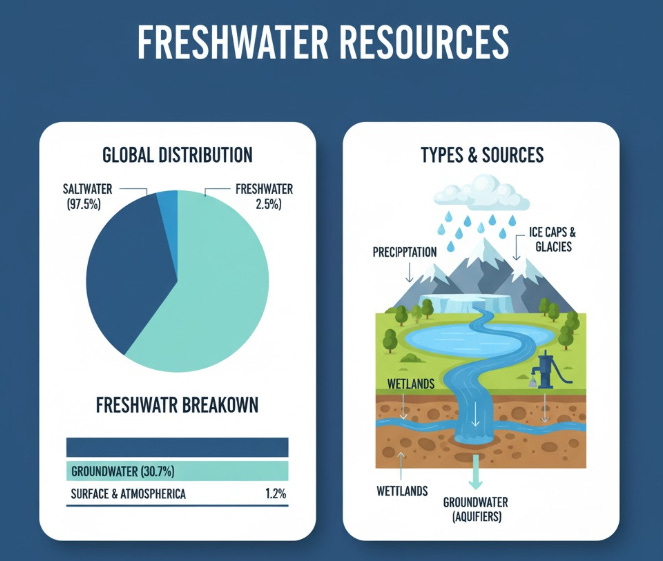
Of even greater volumetric importance is groundwater, which is stored in subterranean layers of permeable rock or sediment known as aquifers. Groundwater represents the largest readily available reservoir of freshwater globally. Its sustainable abstraction is vital, as over-extraction can lead to aquifer depletion, land subsidence, and saltwater intrusion in coastal areas.
Addressing the increasing global demand, coupled with issues of quality degradation, necessitates effective water management. This discipline involves comprehensive planning and policy to ensure the equitable, efficient, and ecologically sound use of water resources. Strategies include implementing water-saving technologies in agriculture and industry, developing efficient infrastructure, and enacting strict regulations to protect water bodies from pollution and overuse.
To explore types of Freshwater Ecosystems in more detail, watch this video.
Summary
Structure and Dynamic Processes of the Geosphere
The Earth’s solid structure is layered, with the rigid lithosphere resting upon the semi-molten asthenosphere beneath it.
The lithosphere is segmented into tectonic plates whose movements are powered by thermal convection currents within the Earth’s mantle.
Interactions at plate boundaries—convergent, divergent, and transform—are the root cause of geological phenomena like earthquakes and volcanism.
These plate movements systematically shape the Earth’s surface, resulting in the formation of continents, mountain ranges, and deep trenches.
Lithospheric Material Cycling
The rock cycle describes the continuous transformation and recycling of materials among igneous, sedimentary, and metamorphic rock types.
The process of weathering, involving both mechanical and chemical forces, is essential for breaking down large rock masses exposed at the surface.
Weathered rock fragments combine with organic material through pedogenesis to form soil, the thin layer vital for terrestrial ecosystems.
Soil composition is influenced by local climate, topography, and parent rock, making it a critical component of land-based life support systems.
The Hydrologic Cycle and Global Circulation
The continuous movement of the hydrosphere is dictated by the hydrologic cycle, which includes key phases such as evaporation, condensation, and precipitation.
Ocean currents are critical for global climate regulation, driven by wind and thermohaline circulation (density differences due to temperature and salinity).
These circulating currents effectively transport heat from equatorial regions toward the poles, which influences temperature moderation worldwide.
The cryosphere, encompassing global ice masses like glaciers and ice sheets, represents a substantial freshwater reserve and contributes to the Earth’s reflective albedo effect.
Management of Essential Freshwater Supplies
Accessible freshwater is stored in surface systems (rivers and lakes) and, more significantly, in underground aquifers known as groundwater reservoirs.
Groundwater constitutes the largest readily available source of freshwater, requiring careful attention for long-term supply viability.
Over-extraction of groundwater can lead to detrimental environmental consequences, including land subsidence and saltwater intrusion in coastal areas.
Effective and comprehensive water management policies are mandatory to ensure the equitable, efficient, and environmentally sustainable use of these finite resources.
Conserving groundwater through household efficiency.
Fix Leaks Immediately: Promptly repairing dripping faucets and running toilets prevents the continuous and silent waste of thousands of gallons of water annually.
Install Low-Flow Fixtures: Replacing old showerheads and faucets with modern low-flow models maintains pressure while significantly reducing water usage per minute.
Run Full Appliance Loads: Maximize water efficiency by operating washing machines and dishwashers only when they are filled to their full capacity.
Practice Water-Wise Landscaping: Use drought-tolerant native plants and mulch in garden areas to drastically minimize the need for supplemental outdoor irrigation.
Answer of the day
What geological process drives the movement of continents and forms major landforms like the Himalayas?
Plate Tectonics
Plate tectonics is the theory that Earth’s outer rigid layer (lithosphere) is divided into large plates that move slowly over the mantle. This motion, driven by internal heat, causes earthquakes, volcanic activity, and the slow, immense collision that builds mountain ranges.
That’s A Wrap!
Want to take a break? You can unsubscribe anytime by clicking “unsubscribe” at the bottom of your email.