

Digital Transformation: Agriculture
Revolutionizing agriculture through aerial crop monitoring, real-time soil telemetry, precision resource application, and data-driven yield management.

Happy Saturday!
Insight Trunk is a free lifetime library—a modern replacement for outdated encyclopedias. From Monday to Saturday, we deliver a 10-minute read on a specific subject, with fresh topics each week. Two years later, we revisit each theme with updated insights from our archives—so you’ll never miss a thing. You can unsubscribe anytime using the link at the bottom of this newsletter.
Today, we explore the fertile ground of AgriTech, where farming meets the future. We will discuss how drones monitor crop health from the sky and IoT sensors track soil moisture below. Discover how precision farming optimizes fertilizer use and farm management software revolutionizes yield tracking for a sustainable harvest.
🧑💻 In this week’s edition: Digital Transformation
Monday - Banking and Finance
Tuesday - Logistics and Supply Chain
Wednesday - Manufacturing
Thursday - Healthcare
Friday - Government
Saturday - Agriculture
Question of the day
What spectral index do agricultural drones use to measure crop health invisible to the naked eye?
Let’s find out !
Agriculture
Let’s break it down in today discussion:
Autonomous Aerial Surveillance for Crop Health
Subsurface Telemetry: The IoT Revolution in Irrigation
Precision Agriculture: Variable Rate Application (VRA)
Farm Management Software (FMS): The Centralized Agronomic Interface
Read Time : 10 minutes
🚁 Autonomous Aerial Surveillance for Crop Health
The integration of Unmanned Aerial Vehicles (UAVs) into agricultural operations has fundamentally advanced the methodology of crop monitoring. Moving beyond traditional, labor-intensive ground scouting, industrial-grade drones now serve as autonomous data acquisition platforms. They provide cultivators with high-frequency, centimeter-level resolution imagery that is inaccessible through conventional satellite feeds, allowing for a near real-time assessment of field conditions across vast acreages.
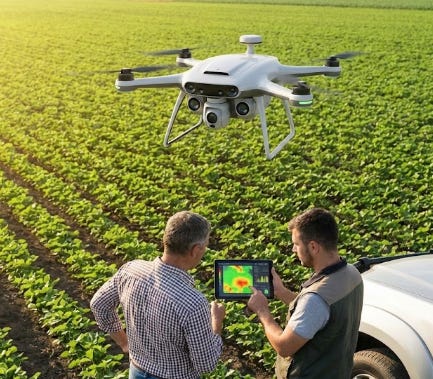
Crucially, these UAVs are often equipped with sophisticated multispectral sensors that capture light reflectance beyond the visible spectrum. By analyzing near-infrared wavelengths, these systems calculate critical indicators such as the Normalized Difference Vegetation Index (NDVI). This spectral data allows agronomists to identify plant physiological stress—resulting from irrigation issues, pest infestations, or nutrient deficiencies—long before visual symptoms become apparent to the naked eye.
This capability facilitates a shift towards proactive, data-driven management. Instead of applying blanket treatments, farmers can utilize drone-generated maps to execute targeted interventions, applying fertilizers or pesticides only to specific, stressed zones. This precision significantly optimizes input costs while simultaneously reducing the environmental footprint of agricultural production.
Learn more about what we discussed by watching this video!
📡 Subsurface Telemetry: The IoT Revolution in Irrigation
The deployment of Internet of Things (IoT) sensors in agriculture has transformed irrigation from an intuitive art into a precise, quantitative science. By embedding wireless sensing probes at varying root depths throughout a field, cultivators can continuously monitor critical subterranean metrics such as volumetric water content, soil temperature, and electrical conductivity (salinity). This constant stream of telemetry replaces the reliance on periodic, manual sampling, providing a dynamic, real-time profile of the soil environment.
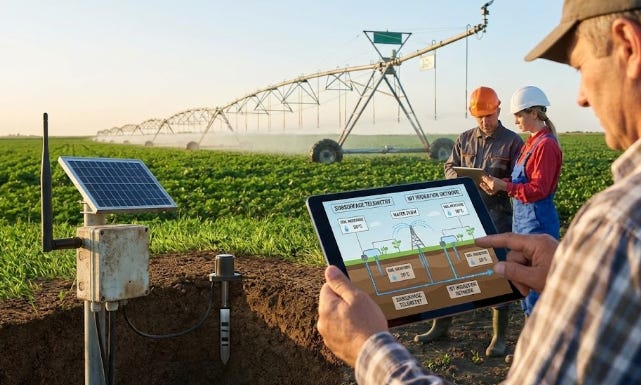
This granular data is instrumental in implementing “Smart Irrigation” strategies. Rather than adhering to rigid, calendar-based watering schedules, farmers can utilize sensor data to trigger irrigation systems only when the soil moisture potential drops below a specific, crop-specific threshold. For example, in high-value vineyards, sensors can maintain vines at a precise level of water deficit to concentrate sugar levels in the grapes, a technique that would be risky to attempt without accurate, real-time feedback.
Ultimately, this data-driven approach yields substantial economic and environmental dividends. By preventing over-watering, operations significantly reduce energy consumption associated with pumping and minimize the leaching of nitrogen fertilizers into groundwater. This optimization not only conserves vital freshwater resources but also protects crop health by mitigating risks associated with root rot and fungal diseases caused by saturation.
Broaden your understanding by watching this video.
🚜 Precision Agriculture: Variable Rate Application (VRA)
The implementation of Precision Farming represents a sophisticated evolution in agronomic management, characterized by the transition from uniform field treatment to site-specific crop care. By synthesizing data from satellite imagery, yield monitors, and soil sampling with high-accuracy Global Navigation Satellite Systems (GNSS), modern agricultural machinery can now navigate fields with sub-inch accuracy. This geospatial framework enables the deployment of Variable Rate Application (VRA) technology, which dynamically adjusts the output of inputs such as fertilizers, seeds, and pesticides based on the specific requirements of each micro-zone within a field.
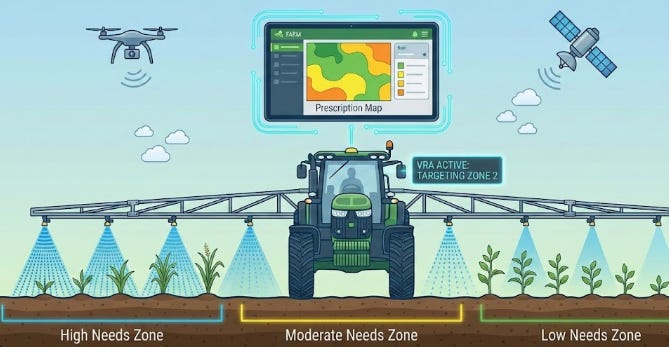
In practice, VRA systems utilize digital “prescription maps” loaded into the tractor’s onboard computer to control the application implements automatically. For instance, rather than spreading a constant rate of nitrogen across an entire hectare, the system can autonomously increase the dosage in zones with high yield potential while reducing it in areas with poor soil structure or adequate existing nutrient levels. This ensures that every plant receives exactly the resources it needs for optimal growth, eliminating the inefficiencies inherent in the traditional “blanket application” approach.
The impact of this technology extends beyond agronomic yield to substantial economic and environmental sustainability. By eliminating the overuse of expensive agrochemicals, producers can significantly widen their profit margins. Simultaneously, this targeted approach drastically mitigates the risk of nutrient runoff into local waterways, aligning intensive agricultural production with stringent environmental stewardship standards.
This video offers comprehensive details on the subject.
📊 Farm Management Software (FMS): The Centralized Agronomic Interface
The adoption of Farm Management Software (FMS) signifies the digitization of agricultural administration, serving as the central nervous system for modern farming operations. These comprehensive platforms aggregate fragmented data streams—originating from aerial drones, IoT soil sensors, and automated machinery—into a unified, cloud-based dashboard. This integration allows farm operators to visualize the entirety of their production cycle in real-time, transitioning management from intuition-based guesswork to a rigorous, data-centric discipline that encompasses everything from inventory control to field planning.
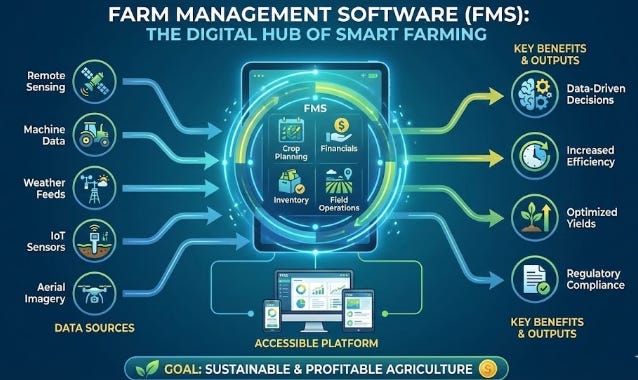
A critical function of FMS is the sophisticated analysis of agronomic performance against financial inputs. By overlaying harvest yield maps with planting and fertilization records, growers can precisely calculate the Return on Investment (ROI) for specific seed varieties or chemical applications across different field zones. For instance, an operator can utilize this historical data to identify that a particular hybrid seed significantly underperformed in sandy soil sections, enabling them to adjust procurement strategies for the subsequent planting season to maximize profitability.
Furthermore, these digital ledgers ensure complete traceability and operational compliance, which are vital for modern supply chains. FMS platforms maintain immutable records of all chemical applications and harvest dates, simplifying the complex documentation required for food safety audits and organic certifications. By streamlining workflow management and labor scheduling, this software empowers producers to treat their farms not merely as biological systems, but as optimized, scalable business enterprises.
For a complete overview, watch this video.
Summary
Agricultural Drones (Aerial Surveillance)
Autonomous Scouting: Drones have replaced labor-intensive manual checking, acting as autonomous scouts that provide high-frequency, high-resolution aerial data.
Invisible Analysis: Equipped with multispectral sensors, drones capture near-infrared light to calculate vegetation indices like NDVI, revealing plant health invisible to the naked eye.
Early Intervention: The technology detects physiological stress (disease, dehydration) days before visual symptoms appear, allowing for preventative action.
Targeted Treatment: Instead of spraying entire fields, farmers can use drone maps to treat only the specific “stress zones,” significantly saving on chemicals.
Superior Accuracy: Unlike satellite imagery which can be blocked by clouds, drones offer on-demand, centimeter-level accuracy for precise field assessment.
IoT Soil Sensors (Smart Irrigation)
Subsurface Intelligence: Wireless probes buried at various depths provide a continuous, real-time profile of soil conditions, including moisture, temperature, and salinity.
Data-Driven Watering: Farmers can shift from rigid, calendar-based schedules to “Smart Irrigation,” triggering water only when sensors indicate the soil actually needs it.
Resource Conservation: This precise approach drastically reduces water waste and energy consumption associated with pumping, lowering operational costs.
Crop Protection: By preventing over-watering, sensors mitigate the risks of root rot and fungal diseases that thrive in saturated soil.
Remote Monitoring: Telemetry is transmitted directly to mobile devices, allowing growers to monitor the status of their fields from anywhere without physical inspection.
Precision Farming (Variable Rate Application)
Site-Specific Management: Precision farming moves away from treating the whole field as one unit, managing different zones based on their specific needs.
Automated Adjustment: Variable Rate Application (VRA) technology allows machinery to automatically adjust the output of seeds or fertilizer based on GPS prescription maps.
Optimized Inputs: Resources are distributed efficiently—higher doses in high-potential zones and lower doses in poor zones—eliminating waste.
Economic Efficiency: By reducing the overuse of expensive agrochemicals, farmers can significantly widen their profit margins and reduce input costs.
Environmental Stewardship: Targeted application prevents excess chemicals from running off into local water sources, ensuring compliance with environmental standards.
Farm Management Software (Centralized Operations)
Digital Central Nervous System: FMS aggregates fragmented data from drones, sensors, and tractors into a single dashboard for a holistic view of farm operations.
Yield Analysis: Farmers can overlay harvest data with input records to calculate the exact ROI of specific seed varieties or soil zones.
Traceability & Compliance: The software creates immutable records of chemical applications, simplifying food safety audits and organic certification processes.
Strategic Planning: Historical data analysis enables evidence-based decision-making for future planting seasons, minimizing risk and maximizing yield potential.
Operational Control: Beyond biology, the platform manages the business side of farming, including inventory tracking, labor scheduling, and financial forecasting.
5 Essential Books on AgriTech & The Future of Farming
“The Fate of Food” by Amanda Little: This engaging narrative explores how robotics, AI, and vertical farming are converging with traditional wisdom to secure our food supply in a changing climate.
“Food 5.0: How We Feed the Future” by Robert Saik: Industry expert Robert Saik offers a pragmatic look at how bioengineering, data, and mechanization are driving the next great revolution in agriculture.
“Tech to Table: 25 Innovators Reimagining Food” by Richard Munson: This book profiles the entrepreneurs and startups that are disrupting the food system, from lab-grown meat to aquaponic vegetable factories.
“Precision Agriculture Basics” by D. Kent Shannon: A perfect practical guide for understanding the fundamental technologies behind GPS guidance, yield monitoring, and variable rate application.
“Clean Meat” by Paul Shapiro: A fascinating deep dive into the world of cellular agriculture and how growing meat without animals could solve the ethical and environmental crises of factory farming.
Answer of the day
What spectral index do agricultural drones use to measure crop health invisible to the naked eye?
The Normalized Difference Vegetation Index (NDVI).
NDVI measures the difference between near-infrared light (which healthy plants reflect) and red light (which they absorb). By capturing this data, drones create detailed maps that highlight plant stress caused by disease or dehydration days before visual signs appear, allowing farmers to intervene precisely where needed.
That’s A Wrap!
Want to take a break? You can unsubscribe anytime by clicking “unsubscribe” at the bottom of your email.