

Critical Thinking: Problem Solving and Argumentation
Constructive application: Structuring clear arguments, evaluating alternatives, and logically defending a chosen solution.

Happy Thursday!
Insight Trunk is a free lifetime library—a modern replacement for outdated encyclopedias. From Monday to Saturday, we deliver a 10-minute read on a specific subject, with fresh topics each week. Two years later, we revisit each theme with updated insights from our archives—so you’ll never miss a thing. You can unsubscribe anytime using the link at the bottom of this newsletter.
Today, we transition to applying critical thought constructively. We will learn to formulate focused questions, develop strong, well-reasoned arguments, examine multiple solutions and perspectives, and logically justify your chosen position based on a solid foundation of evidence.
🧑💻 In this week’s edition: Critical Thinking
Monday - Foundation and Definitions
Tuesday - Analysis and Interpretation
Wednesday - Inference and Evaluation
Thursday - Problem Solving and Argumentation
Friday - Recognizing Logical Fallacies
Saturday - Application and Practice
Question of the day
What makes a problem-solving question effective, distinguishing it from a general inquiry?
Let’s find out !
Problem Solving and Argumentation
Let’s break it down in today discussion:
Formulating a Focused, Clear Question
Developing Well-Reasoned, Strong Arguments
Examining Various Perspectives and Solutions
Justifying Your Chosen Position Logically
Read Time : 10 minutes
🎯 Formulating a Focused, Clear Question
The initiation of any successful problem-solving endeavor hinges upon the precise formulation of the governing question. An effective question must embody both focus and clarity, serving as a well-defined boundary for the subsequent analysis and argumentation. Ambiguity in the initial query inevitably leads to inefficient and unfocused solutions.
A question that is merely general, such as “How can we improve company morale?”, is inherently problematic due to its lack of measurable parameters. The critical thinker must instead transform this into a specific, actionable query, for example: “What specific, low-cost intervention can be implemented within the next 30 days to reduce employee turnover by 5% in the sales department?”

This rigorous formulation ensures that all subsequent data collection, analysis, and proposed solutions are directly relevant to achieving a quantifiable objective. The question must articulate the what, where, when, and how much of the problem, thus dictating the scope of investigation and the criteria for evaluating potential success.
By establishing a clear target at the outset, the critical process avoids the common pitfall of solving an ill-defined problem and facilitates the development of arguments that are inherently targeted and justifiable.
This video offers comprehensive details on the subject.
🏗️ Developing Well-Reasoned, Strong Arguments
The development of strong arguments is central to the constructive application of critical thinking. Such arguments are distinguished not only by their factual content but by their structural integrity, which encompasses both validity and soundness. An argument possesses validity if its conclusion necessarily follows from its premises, irrespective of whether the premises are true. Soundness is achieved when the argument is both valid and all its premises are factually true.
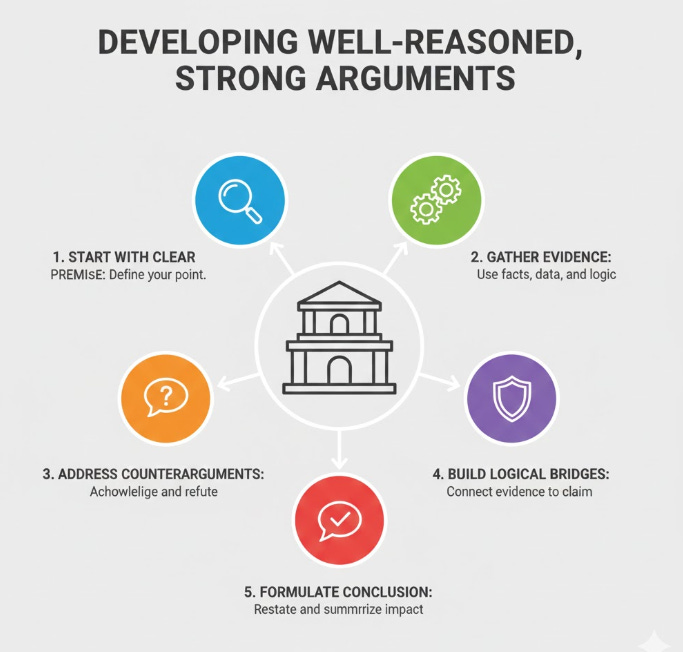
Beyond logical rigor, a strong argument must be persuasive—built upon a sufficient quantity of highly relevant evidence derived exclusively from credible sources. This construction requires anticipating potential counterarguments and proactively integrating rebuttals into the initial structure, thereby minimizing intellectual vulnerability.
For example, arguing for a new municipal ordinance requires premises based on verifiable public safety data and documented cost-benefit analyses, rather than anecdotal citizen complaints. The argument must consistently privilege objective evidence over subjective appeals, maintaining an intellectual distance from emotional or personal vested interests.
By consistently adhering to the standards of logical correctness and factual verification, the arguments constructed serve as robust, justifiable foundations for the proposed solution or position.
Unpack the complexities with the help of this video.
🔄 Examining Various Perspectives and Solutions
A key manifestation of intellectual fairness in critical problem-solving is the disciplined examination of multiple alternatives before a final commitment is made. This process requires transcending confirmation bias by actively seeking and seriously considering viewpoints and solutions that deviate from one’s initial or preferred option. Rushing to adopt the first seemingly viable solution often results in sub-optimal outcomes.
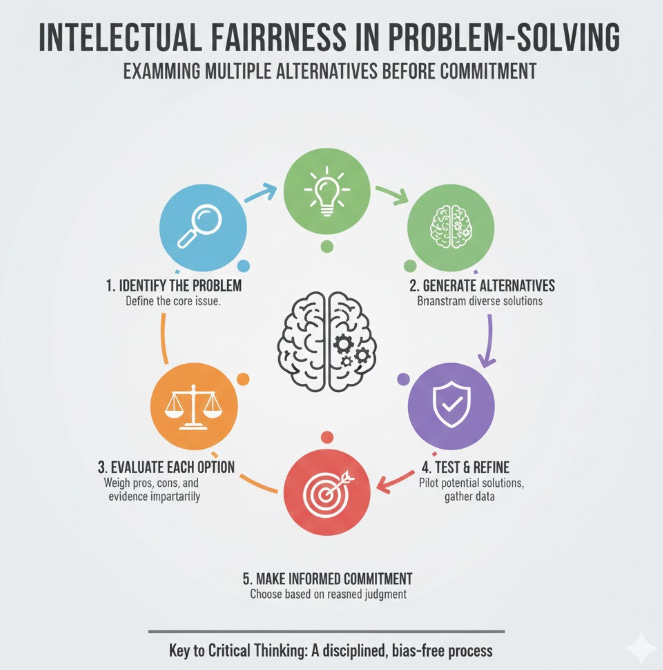
The rigorous examination phase involves evaluating each potential solution against a uniform, objective set of criteria. These criteria typically include variables such as resource efficiency, long-term sustainability, stakeholder impact, and the feasibility of implementation. For instance, when choosing a new supply chain model, solutions must be compared not only on initial cost but also on ethical sourcing and environmental consequences.
Active solicitation of opposing perspectives is mandatory to stress-test the robustness of one’s own assumptions and proposals. This systematic comparison, using data-driven benchmarks, ensures that the selected course of action is truly the most robust and defensible among all considered alternatives.
By deliberately analyzing a diverse range of options, the critical thinker maximizes the probability of identifying the globally optimal solution rather than settling for a locally satisfactory one.
⚖️ Justifying Your Chosen Position Logically
The culmination of critical problem-solving is the articulation of a comprehensive, logical justification for the selected position or solution. This justification must function as a rational defense, explicitly demonstrating that the decision is the product of disciplined analysis and not merely a preference or arbitrary choice.
The process demands a clear, unambiguous statement of the final conclusion, followed immediately by the presentation of the most compelling and relevant supporting premises derived from the analysis phase. Crucially, the justification must also integrate a comparative analysis, explaining precisely why the rejected alternatives failed to meet the objective evaluative criteria (e.g., they were too costly, less sustainable, or lacked sufficient supporting evidence).
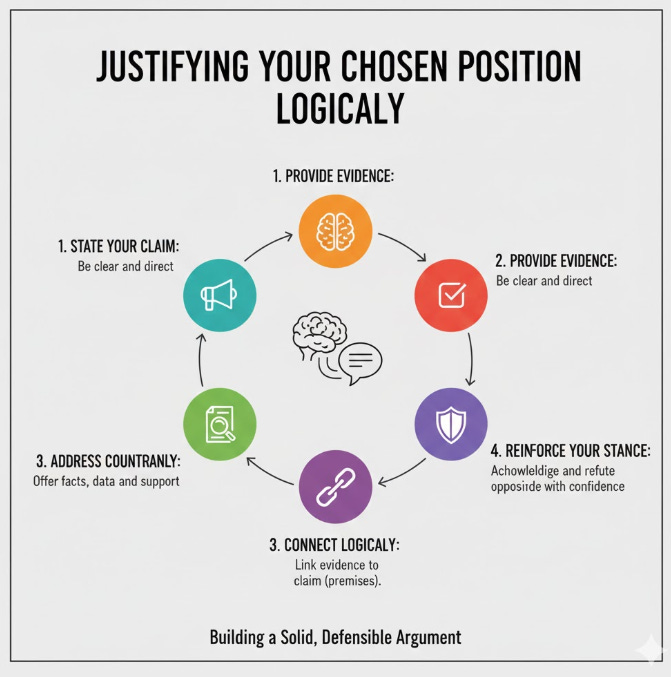
Effective justification anticipates and systematically addresses potential skeptical inquiries, showing that the decision-maker thoroughly considered opposing data and viewpoints. It must clearly demonstrate the logical connections between the evidence, the established criteria, and the final recommendation.
By constructing this rational defense, the critical thinker ensures that their final position is not only sound but also transparently linked to the rigorous, evidence-based process that defined the entire application.
Summary
Defining the Problem Precisely
Successful problem-solving starts with formulating a focused and clear central question.
Vague questions must be transformed into specific, actionable queries with measurable metrics.
The question must clearly define the boundaries and scope of the required solution.
Clarity in the question ensures that all subsequent analysis and solutions are directly relevant.
Building Logically Robust Arguments
Arguments must demonstrate both validity (correct logical structure) and soundness (factually true premises).
Strong arguments are persuasive and built upon sufficient, relevant evidence from credible sources.
Construction should proactively anticipate and integrate rebuttals to possible objections.
Arguments must rely on intellectual rigor and minimize reliance on emotional appeals.
Comprehensive Review of Options
Critical thinking requires the systematic examination of multiple perspectives and alternative solutions.
This process involves actively seeking and fairly assessing viewpoints contrary to one’s own.
Each option must be objectively evaluated against common criteria (e.g., cost, feasibility, impact).
Considering a wide range of options maximizes the chances of finding the optimal and most robust solution.
Providing a Rational Defense
The final step is presenting a clear, logical justification for the chosen position or solution.
The justification must explicitly link the chosen action back to the evidence and initial analysis.
It must include a comparative analysis explaining why rejected alternatives were inferior based on criteria.
The defense should anticipate skeptical inquiry, demonstrating the decision resulted from disciplined, critical thought.
Use a solution comparison matrix.
Define Criteria: Clearly list the objective criteria (e.g., cost, time, impact, feasibility) that will be used to evaluate all options.
List Alternatives: Identify three to five distinct solutions that address the focused problem question.
Assign Scores: Evaluate each solution against every criterion using a simple scoring system (e.g., 1-5).
Total and Justify: Sum the scores to identify the statistically highest-performing solution and then provide a logical justification for the selection.
Answer of the day
What makes a problem-solving question effective, distinguishing it from a general inquiry?
Effective questions are specific and actionable.
A general question is too broad to solve (e.g., “How do we improve the economy?”). An effective, focused question is specific, defining clear boundaries and objectives (e.g., “What specific policy change will reduce youth unemployment by 10% in one year?”). This specificity enables targeted analysis and the development of actionable solutions.
That’s A Wrap!
Want to take a break? You can unsubscribe anytime by clicking “unsubscribe” at the bottom of your email.
The point about avoiding locally satisfactory solutions really stuck with me. I've noticed in tech projects how easy it is to grab the first workable fix and call it done, especailly when deadlines are tight. But that comparison matrix approach could save so much downstream pain. I tried something similar last year when evaluating database options, and forcing myself to score each one against explicit criteria revealed assumptions I didn't even know I had. The discipline of writing down why alternatives failed is underrated tbh.