

Critical Thinking: Foundation and Definitions
Defining the Core: Establishing the essential concepts and acknowledging internal obstacles to clear reasoning.

Happy Monday!
Insight Trunk is a free lifetime library—a modern replacement for outdated encyclopedias. From Monday to Saturday, we deliver a 10-minute read on a specific subject, with fresh topics each week. Two years later, we revisit each theme with updated insights from our archives—so you’ll never miss a thing. You can unsubscribe anytime using the link at the bottom of this newsletter.
Today, we build the foundation of critical thinking skill. We will define critical thinking and distinguish it from mere opinion. Learn to recognize common barriers that cloud judgment and understand why self-reflection is the crucial starting point for clear, effective thought.
🧑💻 In this week’s edition: Critical Thinking
Monday - Foundation and Definitions
Tuesday - Analysis and Interpretation
Wednesday - Inference and Evaluation
Thursday - Problem Solving and Argumentation
Friday - Recognizing Logical Fallacies
Saturday - Application and Practice
Question of the day
What is the fundamental difference between critical thinking and simply having an opinion?
Let’s find out !
Foundation and Definitions
Let’s break it down in today discussion:
Defining Critical Thinking and Foundational Concepts
Identifying Common Barriers to Sound Thinking
Understanding the Difference: Thought Versus Feeling
Recognizing the Importance of Self-Reflection
Read Time : 10 minutes
💡 Defining Critical Thinking and Foundational Concepts
Critical thinking is defined as the intellectually disciplined process of actively and skillfully conceptualizing, analyzing, synthesizing, and evaluating information gathered from, or generated by, observation, experience, reflection, reasoning, or communication. This process is inherently systematic and self-corrective, demanding that the thinker adhere to rigorous intellectual standards rather than relying on intuition or prejudice.

The framework rests on several key intellectual standards. Clarity dictates that questions and statements must be precisely and unambiguously formulated (e.g., replacing “Is the policy good?” with “What are the quantifiable financial impacts of the policy on low-income residents?”). Accuracy requires strict verification of all data and claims to ensure fidelity to facts, while Relevance ensures that every piece of information directly pertains to the core problem being addressed.
Furthermore, critical thinking emphasizes Breadth (considering multiple perspectives), Depth (examining complexity and underlying issues), and Fairness (being impartial and free from self-serving interests). By consciously applying these standards, the goal shifts from simply having an opinion to constructing a judgment that is demonstrably sound and well-supported by evidence.
Watch this video to explore the topic in more detail.
🚧 Identifying Common Barriers to Sound Thinking
The effectiveness of critical thought is frequently impeded by inherent psychological tendencies and biases that operate subconsciously. A principal barrier is egocentrism, the natural human inclination to view all experiences, information, and beliefs exclusively through the lens of one’s own self-centered perspective and immediate desires. This prevents an objective assessment of information that might challenge personal interests.
Similarly, sociocentrism presents a major challenge, causing individuals to uncritically internalize and defend the beliefs, norms, and values of their social group, culture, or community. An example is the automatic dismissal of an argument simply because it originates from an opposing political party, irrespective of its logical merit. This tribal loyalty supersedes the objective search for truth.
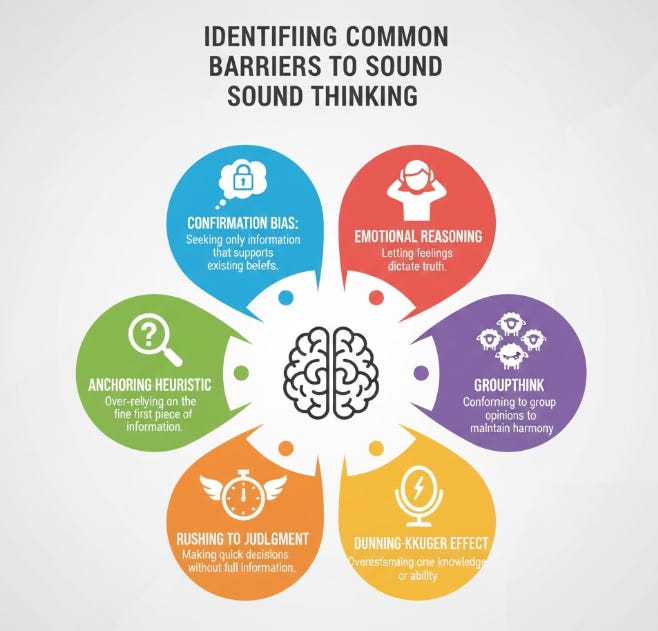
Perhaps the most recognized barrier is confirmation bias, which is the selective seeking, interpreting, and recalling of information in a manner that confirms or supports one’s pre-existing beliefs or hypotheses.
For instance, a person who believes a certain stock will perform well may exclusively read and remember positive financial reports while ignoring contradictory evidence. Overcoming these barriers requires continuous self-awareness and a commitment to intellectual humility.
These cognitive obstacles undermine fairness and accuracy, necessitating a deliberate effort to counteract them for genuine critical engagement.
Get a deeper understanding with this video.
⚖️ Understanding the Difference: Thought Versus Feeling
A cornerstone of critical thinking involves rigorously differentiating between rational thought (reasoning) and subjective feeling (emotion). Rational thought is characterized by its reliance on logical structure, empirical evidence, and adherence to established intellectual standards. It addresses the question: “What are the verifiable facts and valid inferences that support this claim?”
Conversely, feeling constitutes a subjective, often immediate, psychological state or affective response, frequently rooted in personal values, immediate preference, or cultural conditioning. While emotions provide motivation and context, they do not inherently provide justification for a belief. For example, a strong feeling of moral outrage about a policy must be separated from the objective evidence of that policy’s efficacy.
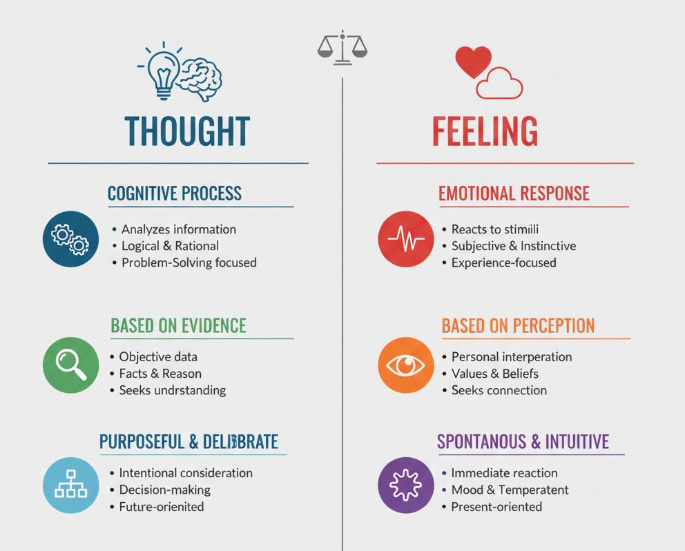
The distinction is crucial because confusing a strong feeling with a strong argument leads to fallacious reasoning. An argument supported by passion alone, such as an appeal to emotion, is intellectually unsound unless that passion is concurrently supported by verifiable data and a logical structure.
The disciplined critical thinker acknowledges feelings but purposefully sets them aside during the evaluation phase to ensure the judgment is based solely on the merits of the evidence and the coherence of the logic. This intellectual neutrality is paramount for reaching fair and objective conclusions.
Watch this video to expand your knowledge.
🔍 Recognizing the Importance of Self-Reflection
Self-reflection, often termed metacognition, is the act of deliberately examining and evaluating one’s own thought processes. This crucial element prevents the uncritical acceptance of one’s own initial assumptions and biases. A critical thinker must continuously turn the analytical lens inward, scrutinizing the methods and principles by which their beliefs were formed.
This practice requires intellectual humility—the awareness of the limits of one’s knowledge and the acceptance that one might be wrong. By routinely asking questions such as, “What data am I potentially overlooking?” or “Have my personal interests skewed my interpretation of the facts?”, the individual actively seeks to identify and mitigate internal sources of error.

For example, when encountering a controversial news item, self-reflection involves assessing whether one is giving undue weight to information that confirms a pre-existing political alignment. It is the necessary check against the barriers of egocentrism and confirmation bias discussed previously.
Ultimately, self-reflection transforms thinking from a passive reaction into an active, disciplined skill. It ensures that the critical process is not only externally focused on the subject matter but internally focused on maintaining the integrity of the thinker’s own reasoning.
Summary
The Discipline of Critical Thinking
Critical thinking is a systematic, self-disciplined process.
It involves skillfully analyzing and evaluating information.
Key standards include ensuring clarity and accuracy of data.
The goal is to form a judgment that is well-reasoned and supported.
The focus is on asking correct questions and demanding evidence.
Recognizing Cognitive Roadblocks
Psychological tendencies often obstruct objective thought.
Egocentrism involves judging everything solely by personal views.
Sociocentrism causes uncritical acceptance of group beliefs.
Confirmation bias leads to seeking only supportive evidence.
Overcoming these barriers requires dedicated self-awareness.
Separating Reason from Emotion
A core skill is distinguishing rational thought from subjective feeling.
Rational thought relies fundamentally on evidence and logical structure.
Feelings are subjective responses, not justifications for beliefs.
Mistaking passion for proof leads to intellectually unsound arguments.
Intellectual neutrality must be maintained during the evaluation phase.
The Power of Introspective Analysis
Self-reflection is the deliberate examination of one’s own thinking.
It serves as a constant check against biases and assumptions.
This practice requires accepting the limits of one’s own knowledge.
It involves asking if one’s personal interests are swaying the analysis.
Self-reflection ensures the integrity and fairness of final conclusions.
Three simple daily checks.
The Clarity Check: Before accepting any information, ask yourself, “Do I fully and precisely understand every concept being presented?”
The Barrier Check: When you feel strongly about a topic, pause and ask, “Is my personal bias or group loyalty clouding my judgment on the facts?”
The Evidence Check: Always distinguish between emotional reaction and proven fact by asking, “What objective data or logic supports this conclusion, and is it sufficient?”
Answer of the day
What is the fundamental difference between critical thinking and simply having an opinion?
Critical thinking uses evidence; opinion relies on feeling.
Critical thinking is a structured process using logic, objective evidence, and analysis to form a reasoned judgment. An opinion, conversely, is a subjective belief often rooted in personal feelings, values, or immediate preferences, lacking the rigorous, objective standards required by critical analysis.
That’s A Wrap!
Want to take a break? You can unsubscribe anytime by clicking “unsubscribe” at the bottom of your email.
Hello there friend, I hope you’re having a wonderful weekend.
Your notes have appeared on my feed the past few days, always worth pondering, thank you.
I thought you may enjoy this article of mine:
https://open.substack.com/pub/jordannuttall/p/diseases-plants-and-forgotten-medicine?r=4f55i2&utm_medium=ios&shareImageVariant=overlay