

Critical Thinking: Application and Practice
The critical disposition: Managing bias, embracing self-correction, and maintaining genuine openness to new evidence.

Happy Saturday!
Insight Trunk is a free lifetime library—a modern replacement for outdated encyclopedias. From Monday to Saturday, we deliver a 10-minute read on a specific subject, with fresh topics each week. Two years later, we revisit each theme with updated insights from our archives—so you’ll never miss a thing. You can unsubscribe anytime using the link at the bottom of this newsletter.
Today, we focus on the essential disposition of a critical thinker. We will learn to recognize and manage cognitive biases, understand the value of self-correction, and foster a genuine openness to new evidence and perspectives, even when they challenge our core beliefs.
🧑💻 In this week’s edition: Critical Thinking
Monday - Foundation and Definitions
Tuesday - Analysis and Interpretation
Wednesday - Inference and Evaluation
Thursday - Problem Solving and Argumentation
Friday - Recognizing Logical Fallacies
Saturday - Application and Practice
Question of the day
What specific action demonstrates intellectual humility when presented with contradictory evidence?
Let’s find out !
Application and Practice
Let’s break it down in today discussion:
Recognizing and Managing Cognitive Biases
The Value of Self-Correction
Fostering Genuine Openness to New Evidence
Embracing Intellectual Humility
Read Time : 10 minutes
🤔 Recognizing and Managing Cognitive Biases
A core tenet of advanced critical thinking is the acceptance that absolute objectivity is unattainable due to the ubiquitous presence of cognitive biases. These biases are systematic, inherent deviations in judgment that lead to irrational decision-making, compelling individuals to interpret information in ways that reinforce pre-existing beliefs. Effective critical analysis requires continuous vigilance against these ingrained mental shortcuts.
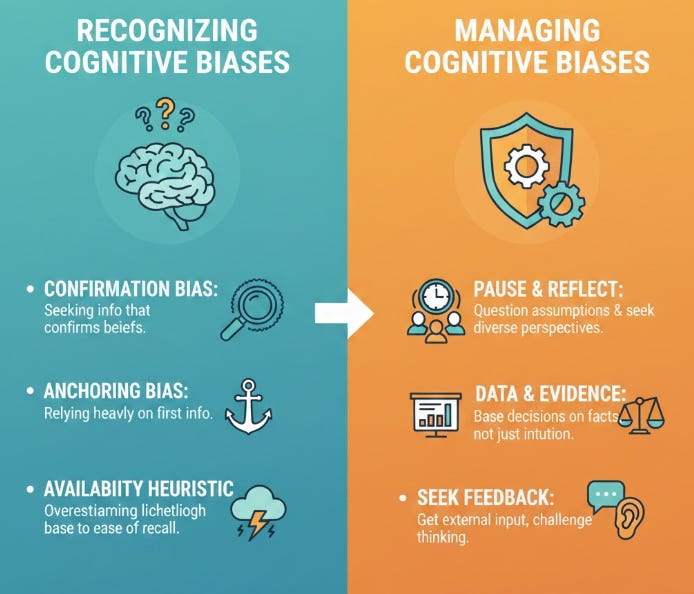
The most potent of these is Confirmation Bias, which represents the subconscious inclination to selectively seek, favor, and interpret evidence that validates one’s existing hypotheses, while simultaneously discounting or ignoring contradictory data. For example, a manager who believes a certain team member is unproductive will unconsciously over-focus on minor delays while dismissing instances of high performance.
Managing these biases necessitates the deliberate adoption of counter-strategies, such as formally articulating the strongest possible argument against one’s own position before proceeding. This intentional self-challenge forces the evaluation of evidence without the immediate protective shield of personal preference.
By proactively recognizing and mitigating these systematic errors, the critical thinker ensures that the analytical process is driven by evidential rigor rather than psychological comfort.
Learn more about what we discussed by watching this video!
⬆️ The Value of Self-Correction
The capacity for self-correction is the definitive sign of a mature critical thinker, signifying a stronger commitment to objective truth than to the maintenance of intellectual consistency or personal ego. It involves the candid acceptance of error when presented with new evidence or a logically superior argument that invalidates a previously held belief or conclusion.

When a conclusion is challenged by robust data, the appropriate response is not defensiveness, but the deliberate and public revision of one’s stance. For instance, a scientist who finds data contradicting their initial hypothesis must abandon the hypothesis, regardless of the time invested in its development. This willingness to modify one’s view ensures continuous alignment with the most current and best-supported understanding of reality.
Self-correction acts as a powerful engine for knowledge refinement. It prevents the stagnation of thought and drives intellectual progress by systematically weeding out erroneous ideas.
This internal mechanism ensures that the critical thinker’s belief system remains dynamic and responsive to evidence, prioritizing accuracy and veracity over the comfort of being perpetually “right.”
👂 Fostering Genuine Openness to New Evidence
Genuine openness represents an active, non-defensive posture toward information that directly contradicts or significantly challenges one’s existing mental models and deeply held convictions. This goes beyond mere tolerance; it requires giving fair and rigorous consideration to counter-evidence, applying the same critical standards used to evaluate information that supports one’s own views.

The critical thinker must deliberately seek out diverse, high-quality sources that offer alternative perspectives. For instance, when evaluating a company merger, genuine openness means actively studying the analysis provided by a skeptical consumer group with the same intellectual diligence given to the optimistic reports from the company’s internal finance department. This avoids the intellectual complacency that results from only engaging with agreeable sources.
Fostering this disposition necessitates the recognition that truth is rarely simple or monolithic, and that a single perspective seldom possesses a monopoly on correct understanding. Openness drives intellectual growth by ensuring that one’s understanding is perpetually tested against the full spectrum of available data and reasoned arguments.
By embracing this principle, the critical thinker maintains a permeable boundary for new knowledge, ensuring that their conclusions are based on the most complete and intellectually tested dataset possible.
🧘 Embracing Intellectual Humility
Intellectual Humility is the essential disposition of accurately assessing and acknowledging the inherent limitations of one’s own knowledge. It is the understanding that one’s comprehension of any complex subject is necessarily incomplete, provisional, and susceptible to error. This modesty is a powerful antithesis to intellectual arrogance, which often leads to dogmatic certainty unjustified by the evidence.

This disposition encourages the use of precise, conditional language in communication. Instead of making absolute pronouncements, the intellectually humble thinker employs qualifiers like “The current evidence suggests,” or “Based on this data, it appears,” thereby acknowledging the possibility of future revision.
For example, when an expert expresses certainty on a topic, intellectual humility prompts them to acknowledge the boundaries of their expertise and the potential for new scientific discoveries to overturn established views. This commitment to intellectual modesty ensures that the individual remains perpetually teachable.
By embracing intellectual humility, the critical thinker dedicates themselves not to the defense of a personal position, but solely to the continuous, evidence-based pursuit of the most accurate understanding.
Summary
The Necessity of Managing Cognitive Biases
Critical thinkers must acknowledge that their judgment is systematically influenced by inherent cognitive biases.
Confirmation Bias is the most common, causing individuals to favor information that supports their existing beliefs.
Effective management requires constant self-reflection and the intentional adoption of strategies to challenge one’s own viewpoints.
By mitigating bias, the analysis is guided by evidential rigor rather than psychological comfort.
Committing to Self-Correction
The defining mark of a mature critical thinker is the strong commitment to truth over personal ego.
Self-correction means willingly revising a conclusion when new evidence or a superior argument proves the original wrong.
The appropriate response to invalidated beliefs is deliberate revision, not intellectual defense.
This dynamic process continuously upgrades one’s understanding to align with the most robust information available.
Actively Cultivating Openness
Openness is the active, non-defensive willingness to receive and consider evidence that challenges one’s convictions.
Genuine openness requires analyzing counter-arguments with the same rigor applied to supportive evidence.
Critical thinkers must deliberately seek out diverse perspectives to subject them to impartial analysis.
This disposition ensures that one’s conclusions are tested against the full spectrum of available data, preventing intellectual complacency.
Practicing Intellectual Humility
Intellectual Humility is the realistic acknowledgement of the limits and potential errors in one’s own knowledge.
This disposition is the opposite of intellectual arrogance, which assumes certainty without sufficient evidence.
Humility encourages the use of conditional language (e.g., “The current evidence suggests...”) rather than dogmatic pronouncements.
By embracing humility, the critical thinker remains perpetually teachable and focused on the best available truth.
Practice the “Devil’s Advocate” method.
Check for Character Attacks: See if the argument focuses on the person’s character or motives instead of the facts being discussed.
Look for Topic Shifts: Determine if an irrelevant issue is introduced specifically to distract from the original, difficult point.
Verify Position Accuracy: Compare the argument being attacked to the opponent’s actual stated position to spot any distortion.
Isolate Emotional Appeals: Identify if strong feelings (like fear or pity) are being used as a substitute for logical evidence.
Answer of the day
What specific action demonstrates intellectual humility when presented with contradictory evidence?
A willingness to revise one’s original conclusion.
Intellectual humility is demonstrated by a readiness to admit that one’s initial conclusion may be incorrect in light of new, stronger evidence. Revising a conclusion shows a commitment to truth over ego. This self-correction ensures that one’s beliefs are continuously aligned with the best available data, which is the hallmark of a disciplined critical thinker.
That’s A Wrap!
Want to take a break? You can unsubscribe anytime by clicking “unsubscribe” at the bottom of your email.
Regarding the topic of the article, I appreciate the emphasis on confronting cognitive biases and fostering intellectual humility, which are undoubtedly crucial elemants for effective critical thinking in any field.
Solid breakdown of how bias management and self-correction interact. The confirmation bias example with the manager overlooking strong performance really captures how this plays out in real setings. What stands out is the point about using conditional language instead of absolutes - it's subtle but makes a masive difference in group decision-making. I've seen teams where everyone defaults to certainty and it kills healthy debate. The devil's advocate method at the end is practical too, especially isolating emotional appeals from actual logic.