

Computer Science: Software Development and Design
Applying systematic methodologies and best practices to build, test, and manage large-scale software projects.
Happy Thursday!
Insight Trunk is a free lifetime library—a modern replacement for outdated encyclopedias. From Monday to Saturday, we deliver a 10-minute read on a specific subject, with fresh topics each week. Two years later, we revisit each theme with updated insights from our archives—so you’ll never miss a thing. You can unsubscribe anytime using the link at the bottom of this newsletter.
Today, we introduce Object-Oriented Programming (OOP) for modeling real-world entities. We explore the Software Development Life Cycle (SDLC) for project structure. Finally, learn about essential practices like version control (Git) and the importance of testing for robust code.
🧑💻 In this week’s edition: Computer Science
Monday - Foundations of Computing
Tuesday - Programming Fundamentals
Wednesday - Data Structures and Algorithms
Thursday - Software Development and Design
Friday - Networking and the Internet
Saturday - Advanced Topics and Future Trends
Question of the day
Which OOP principle allows an object to take on many forms?
Let’s find out !
Software Development and Design
Let’s break it down in today discussion:
Object-Oriented Programming (OOP) Concepts
Software Development Life Cycle (SDLC)
Version Control and Collaboration (Git)
Testing, Debugging, and Code Quality
Read Time : 10 minutes
🧱 Object-Oriented Programming (OOP) Concepts
Object-Oriented Programming (OOP) is a dominant programming paradigm focused on structuring software around data, or objects, rather than functions and logic. Objects are instances of classes, which act as blueprints defining the attributes (data) and methods (behavior) that the object possesses. This approach is highly effective for modeling real-world entities and managing the scale of complex software systems.
The power of OOP is derived from its four foundational principles. Encapsulation involves bundling data with the methods that operate on that data and restricts direct access to the internal state. This protects data integrity and simplifies the code interface, as users only interact with public methods. For example, a Car object might encapsulate its speed attribute, which can only be changed via the accelerate() or brake() methods.
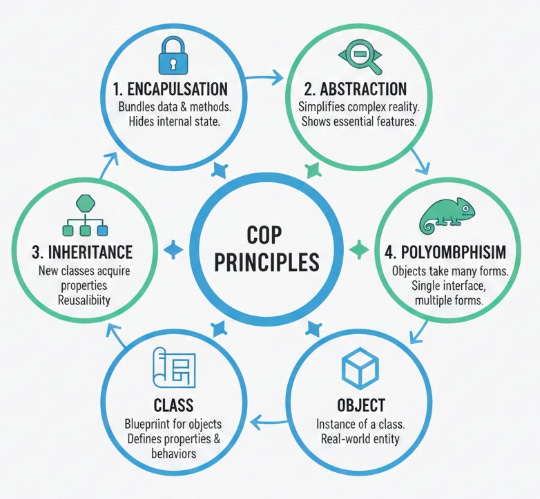
Inheritance allows a new class (the subclass or derived class) to adopt the properties and behaviors of an existing class (the superclass or base class). This promotes significant code reuse, as common functionality is defined once and shared across a hierarchy of related objects. The principle of Abstraction further simplifies complexity by showing only essential information to the user while hiding the complicated implementation details.
Finally, Polymorphism (”many forms”) enables objects to respond to the same message or method call in different ways depending on their class. This allows for flexible and versatile code, where a single function signature can handle objects of various types, a critical feature for developing scalable and adaptable applications.
This video offers comprehensive details on the subject.
🗺️ Software Development Life Cycle (SDLC)
The Software Development Life Cycle (SDLC) is a structured methodological framework that governs the entire process of developing, modifying, and maintaining software. Its purpose is to ensure that the final product is delivered efficiently, on time, and accurately satisfies the stated user requirements. Various models, such as Waterfall, Agile, and Spiral, structure the project, but they share a common sequence of phases.
The initial phase, Planning and Requirements Gathering, establishes the project scope, identifies necessary resources, and formally documents the client’s needs and functional specifications. This is followed by the Design phase, where the system architecture is conceived, including database models, software modules, interface designs, and algorithms. Proper design minimizes errors and rework in later stages.
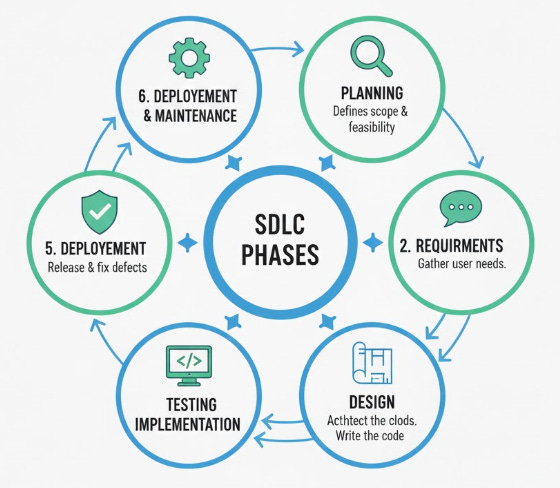
Next is the Implementation phase, where the design is translated into executable code. This is where programmers write the software using the chosen programming language and tools. Following implementation is the crucial Testing phase, where the software is rigorously evaluated against the initial requirements to detect and rectify errors, ensuring quality and reliability.
The final stages involve Deployment, which makes the software available for end-users, and subsequent Maintenance. Maintenance is an ongoing activity that includes correcting post-release bugs, adapting the software to new operating environments, and enhancing functionality based on user feedback. The SDLC is vital for managing large-scale projects by providing necessary structure and milestones.
Unpack the complexities with the help of this video.
🤝 Version Control and Collaboration (Git)
Version Control Systems (VCS) are essential software tools designed to manage changes to source code over time. They track every modification made to a file, creating a complete historical record. This capability allows developers to revert to previous versions, audit changes, and understand who made specific modifications, which is indispensable for maintaining project integrity and stability.
Git stands as the industry-standard distributed VCS. Its distributed nature means that every developer has a full, local copy of the entire codebase and its history, enabling offline work and reducing dependency on a central server. The core workflow in Git revolves around commits, which are snapshots of the repository at a specific point in time, and the ability to navigate between them.

The most critical function of Git in collaborative environments is its support for branching and merging. A branch is an isolated line of development, allowing a developer to work on a new feature or fix a bug without impacting the stable, main codebase (often called the main or master branch). Once the work is complete and validated, the changes are integrated back into the main line through a merge operation. This workflow is central to modern, concurrent team development.
Platforms like GitHub and GitLab host these Git repositories, providing a web interface for code review, issue tracking, and synchronized collaboration among geographically dispersed teams, solidifying Git’s role as the backbone of contemporary software engineering practices.
Take your learning further by watching this video.
🔍 Testing, Debugging, and Code Quality
The final stages of the software development lifecycle are dedicated to validating the reliability and functionality of the codebase through testing and ensuring its correctness via debugging. Testing is a systematic process of executing the program with the intent of uncovering defects, or “bugs,” before the product reaches the end-user.
Testing is classified into various levels. Unit Tests verify the correctness of the smallest, isolated components, typically individual functions or methods. Integration Tests then ensure that these different units work together correctly as a group. Finally, System Tests assess the functionality and performance of the entire software product against its original requirements, often performed from the end-user’s perspective.

When a defect is identified, debugging commences. This involves locating the exact source of the error, analyzing the cause, and implementing a fix. Programmers frequently utilize specialized debugging tools that allow them to step through the code execution line by line, inspect the values of variables, and observe the program’s state to trace the logical failure. Systematic debugging reduces the time and effort required to resolve complex issues.
Beyond mere functionality, Code Quality is paramount. High-quality code is characterized by its readability, maintainability, and adherence to established coding standards. Practices like comprehensive documentation, consistent naming conventions, and frequent code reviews by peers ensure that the software is not only bug-free but also easy for future developers (including the original author) to understand and modify, thereby minimizing future technical debt.
For a complete overview, watch this video.
Summary
Object-Oriented Programming (OOP) Principles
OOP structures software around objects that combine data and behavior, modeling real-world entities.
Encapsulation protects an object’s internal data by restricting direct access, requiring interaction through defined methods.
Inheritance allows new classes to reuse code by adopting properties and methods from parent classes.
Polymorphism enables a single interface to handle objects of different types, promoting flexibility and scalability.
Structuring the Project (SDLC)
The Software Development Life Cycle (SDLC) provides a formal framework for managing the creation and evolution of software.
It begins with Planning and Requirements Gathering to define the project scope and client needs.
The Design phase involves architecting the system’s structure and components before coding begins.
The life cycle continues through Implementation, Testing, Deployment, and ongoing Maintenance.
Collaboration and History Tracking (Version Control)
Version control systems (VCS) like Git track every change made to the codebase over time.
Git’s distributed nature means every developer maintains a complete local history of the code.
Branching allows developers to work on new features in isolation from the stable main codebase.
Merging integrates the completed, validated changes from a branch back into the main project line, enabling collaboration.
Ensuring Reliability (Testing and Quality)
Testing is the systematic execution of a program to find defects (bugs) before deployment.
Unit Tests check small, individual components, while System Tests check the entire product against requirements.
Debugging is the process of locating, analyzing, and fixing the errors found during testing.
Code Quality is maintained through coding standards and code reviews, ensuring the software is readable and maintainable long-term.
Essential Git commands for version control.
git initis the command used to initialize a new local Git repository in your current working directory.git clone [url]copies an existing remote repository from a server to your local machine, creating a new local repository.git add .stages all modified files in the current directory, marking them to be included in the next commit.git commit -m “Message”permanently records the staged changes into the repository’s history with a descriptive message.git statusdisplays the state of the working directory and the staging area, showing which files are tracked, modified, or staged.git pushtransfers your local commits to the remote repository, sharing your changes with collaborators.git pullfetches and integrates changes from the remote repository into your current local branch, keeping your work up-to-date.
Answer of the day
Which OOP principle allows an object to take on many forms?
Polymorphism principle
Polymorphism is a core OOP concept meaning “many forms.” It allows a single interface to represent different underlying forms or data types. This enables methods to behave differently based on the object calling them, promoting flexible and reusable code in large software development projects.
That’s A Wrap!
Want to take a break? You can unsubscribe anytime by clicking “unsubscribe” at the bottom of your email.
This article comes at the perfect time, especialy loved the part on testing for robust code, which is so crucial for my students.
I appreciate the clean breakdown of OOP principles. The encapsulation example with the Car object really helped clarify why direct access to attributes can be problematic. Have you found that beginers typically grasp polymorphism faster when taught through real world examples versus abstract concepts?